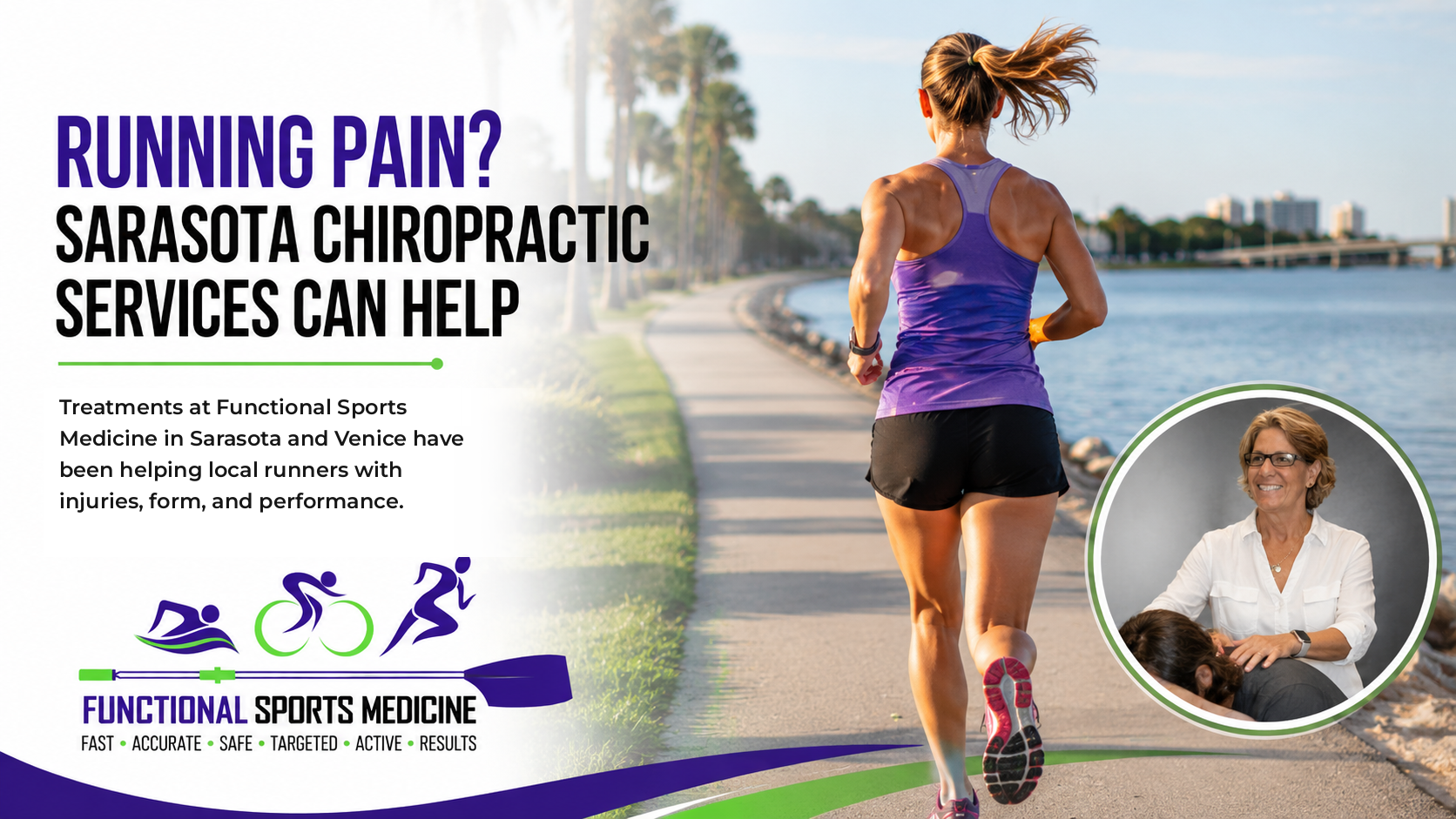
Running is one of the most accessible forms of exercise out there. It requires virtually no equipment beyond a little determination. And for many people in Sarasota, running is a passion. Especially at Nathan Benderson Park, where you can find all types of people walking and running.
But don’t let the simplicity of the sport fool you. A lot can hamper your running performance and lead to pain and even injuries. And when pain gets in the way of getting your miles in, your friendly Sarasota chiropractor is here to help.
Running issues can be from acute injury or chronic, long-developing wear and tear. And while you might think running is all about the lower half of your body, a good performance on the road or the track requires whole-body engagement and coordination. Every movement correlates with things happening throughout your body. And of course, the goal is not just to heal the injury; it’s to prevent it from happening again in the future.
Of course, chiropractic treatments aren’t just about recovery. As a specialist in functional sports medicine and rehab, I love to be a part of optimizing and enhancing athletic performance. By looking at form and synchronicity from top to bottom, I’m able to pinpoint movements that can be improved and facilitate better form and performance—even in world-class athletes who’ve been training for years.
Here are some common running issues, and how chiropractic treatments can help.
Achilles Tendinitis/Tendinosis
The achilles tendon is the substantial cord of connective tissue running from your heel to your calf muscle. (In fact, it’s the thickest and strongest tendon in the human body.) It’s what allows you to point your toes—so for runners especially, the achilles tendon has a very important job to do, and it gets a lot of use.
Tendonitis is an acute or new injury which simply means the tendon is inflamed; tendonosis is a chronic or long-standing injury with very little inflammation and actually means the tissue has begun to break down, stiffening movement and putting you at risk for a partial or full achilles tear—which is a catastrophic injury for any athlete.
Treatment: While rest is important, I also employ a more proactive approach. Using a combination of therapeutic modalities such as ultrasound, Estim as well as Graston and other soft-tissue techniques with mobility exercises and strength exercises. Utilizing these therapies, I can help ensure that not only is the tendon stronger, but the runner’s overall form now supports a stride that will put less pressure on the achilles in the future.
Illiotibial (IT) Band Syndrome
Pain on the outside of the knee or hip? It’s very likely IT band syndrome.
The IT band is a ligament that stretches down the outside of the upper leg, from the iliac crest at your waist it all the way down to just below the knee on the outside attaching to the tibia. The IT band is one to the strongest supporting soft tissue structures of the leg which supports the stability of the knee. IT band syndrome, when that ligament becomes inflamed, is a very common issue with runners.
Treatment: Functional sports medicine treatments for IT band syndrome center on improving flexibility and mobility of the IT band itself, as well as the correlating soft tissue, especially the hip flexors. In addition to stretching and mobility exercises, I will utilize well known soft tissue techniques to release the myofascial tightness and stiffness in the tendon and muscles of the region. These techniques include hands on movements as well as instrumental assisted soft tissue mobilization and cupping. These treatments will further loosen the soft tissue, trigger tissue repair, and stimulate the lymphatic system to remove excess fluid and waste from the area.
Knee pain/Runners Knee
Runner’s knee (or Patellofemoral pain syndrome) manifests with pain at the front of the knee as the kneecap (patella) rubs against the femur. There can be any number of causes—from injury or tightness to misalignment or the nature of your stride—so it’s very important, as always, to perform a full examination, including a hands-on analysis as well as studying how you move and how your patella responds to those movements.
Treatment: Only once I fully understand the cause of your pain, can I begin developing a treatment plan. It might include ultrasound, ESTIM, soft tissue/myofascial release as well as exercises, stretching, and ways to adjust your stride or even a change of runner shoe (yes, knee pain can come from your shoes)!
Plantar Fasciitis
Plantar fasciitis is very common injury in runners. Approximately 1-2 million people in the United States suffer from Plantar Fasciitis each year. More than 10% of runner will experience this year alone! Plantar fasciitis is pain on the bottom of your foot, most occurring when you first get up in the morning or take you first steps after sitting for long periods. It can stop a runner dead in their tracks and take months to resolve if left untreated.
Treatment: The key to treating plantar fasciitis is catching it early. Most resolve with four to six treatments. Our treatment includes ultrasound, ESTIM, soft tissue/myofascial release as well as exercises, stretching, and ways to adjust your stride. And yes, changing your running shoe will more than likely help, but NOT going to a stiffer shoes. Instead we help train the foot by strengthening it as well as loosening up the calf, hamstring and glutes.
I also have years of experience with kinesiotaping, which I have been using with my patients since 1995. KinesioTape or Kinesiology Tape supports the tissues without restricting any motion of the joint it is applied to. Kinesiotape works by lifting the skin up off the structures under it, allowing for more room for the tissues to glide as well as taking pressure off the pain receptors of the area. This allows the athletes to continue to perform while supporting healthy joints and soft tissue.